
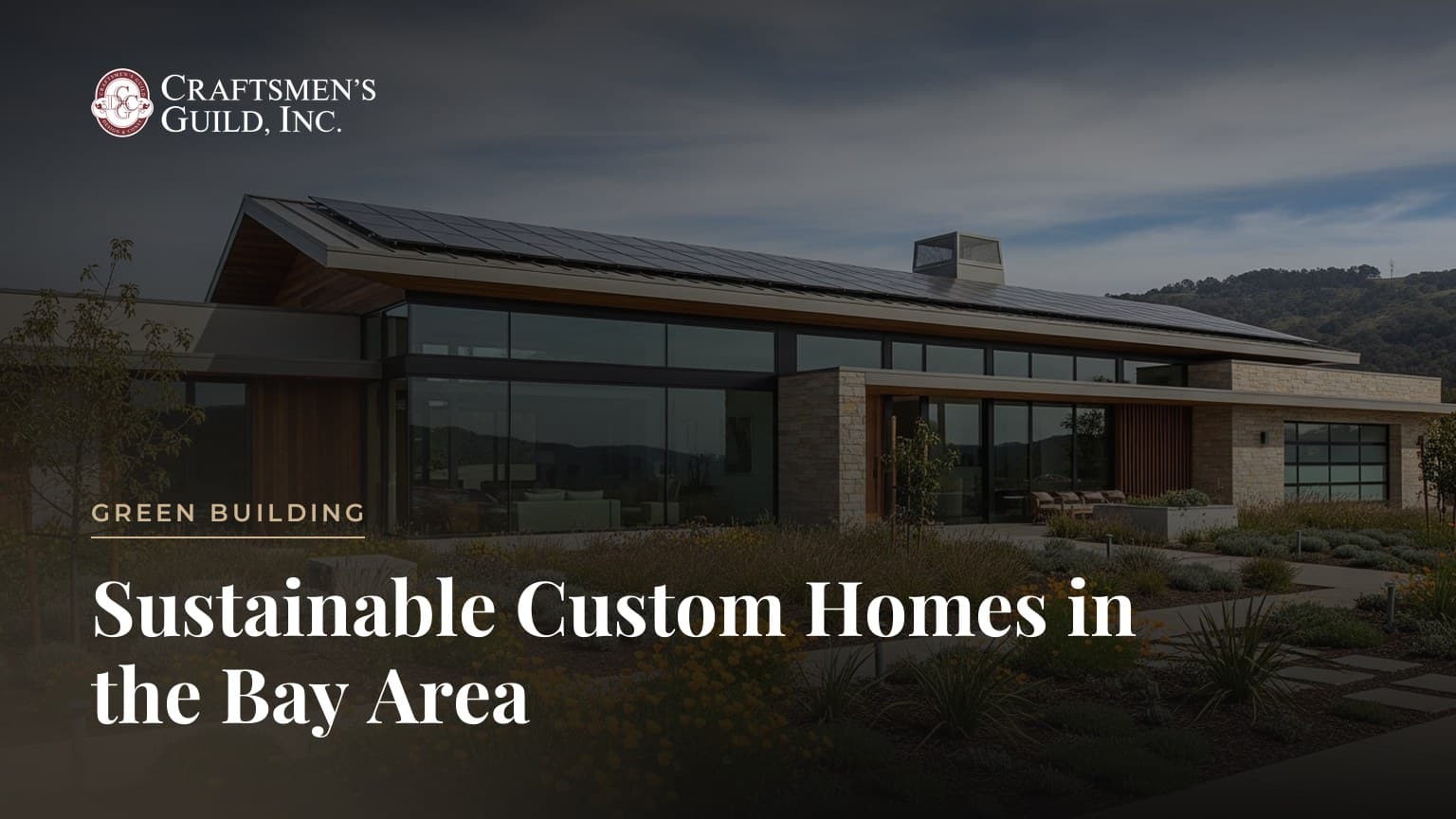
Short answer: Sustainable custom homes in the Bay Area combine solar power, all-electric systems, tight building envelopes, and efficient water use to cut operating costs and carbon over the life of the home. California's 2025 Title 24 energy code now makes many of these features standard, requiring solar on most new single-family homes and favoring heat pumps for heating. Green building raises upfront cost modestly while lowering monthly bills and boosting long-term value.
Sustainability in a custom home is no longer a niche upgrade. It is increasingly the baseline, driven by state code and by buyers who expect efficient, healthy houses. This guide explains what a sustainable custom home includes, what the law requires, and where the payoff comes from.
Last updated: July 2026
What are sustainable custom homes?
Sustainable custom homes are houses designed to minimize energy and water use, reduce carbon, and stay comfortable with less mechanical effort, achieved through solar, efficient systems, quality insulation, and smart material choices. In California, much of this is now required rather than optional: the 2025 Title 24 code prescriptively mandates a solar PV system on most new single-family homes. [Source: California Energy Commission 2025] The goal is a home that costs less to run and lasts longer, not one that sacrifices comfort or design.
In practice, that means pairing a well-sealed, well-insulated envelope with efficient electric systems and on-site solar generation. The envelope, meaning the walls, roof, windows, and air sealing, does the quiet work of holding conditioned air inside so the mechanical systems run less. Orientation and shading matter too, since a home designed to catch winter sun and block summer heat needs less energy before any equipment is switched on. Our overview of custom home construction shows how these elements are planned from the outset, and our deep dive on net-zero construction explores the most ambitious end of the spectrum.
What does California's 2025 Title 24 code require?
California's 2025 Title 24 energy code prescriptively requires a solar PV system on most new single-family homes, typically sized between 2.5 and 5 kW based on the home's floor area and climate zone. [Source: California Energy Commission 2025] The code has also moved to a single-fuel baseline that effectively makes heat pumps the standard for space and water heating.
New homes must include electric-ready panels and infrastructure to support future electrification, including panel capacity and conduit for electric cooking, drying, and heating. [Source: California Energy Commission 2025] Builders who add battery storage of 5 kWh or more alongside solar earn a compliance credit that can reduce the required solar system size. These rules make sustainability a design question every Bay Area build must answer, as our San Jose projects reflect.
Does building sustainably cost more?
Sustainable features add modest upfront cost against a full custom budget, and much of it is now required rather than optional. For reference, Bay Area custom construction runs $500 to $750 per square foot, with luxury builds higher, and code-required solar and electrification sit inside that figure rather than on top of it. [Source: White Palace Construction 2025]
The tradeoff favors the long term. Solar and heat pump systems raise the initial number while lowering monthly energy costs for the life of the home, and rooftop solar returns roughly 41 percent of its cost at resale in the Pacific region. [Source: Zonda 2025] Framing the decision as lifetime cost, not sticker price, is what makes the math work. Incentives can soften the upfront number further, since federal and utility programs periodically offer credits or rebates for solar, storage, and heat pumps that a builder can help you fold into the plan. Our breakdown of high-end construction explains how premium builds absorb these systems.
How do sustainable homes lower operating costs?
Sustainable homes cut monthly costs through generation and efficiency working together: on-site solar offsets electricity use, heat pumps deliver heating and cooling at high efficiency, and a tight envelope reduces the load in the first place. Because the 2025 Title 24 code sizes required solar to the home's projected annual electricity use, a well-designed system can offset a large share of a home's power draw. [Source: California Energy Commission 2025] The result is a home that needs less purchased energy year-round.
Water efficiency compounds the savings, and it matters in drought-prone California. Low-flow fixtures, efficient irrigation, and thoughtful landscaping reduce water bills and demand. Heat pump water heaters, now the code-favored standard, use far less energy than gas or electric-resistance units, trimming one of the larger line items on a monthly utility bill. Pairing solar with a battery lets a household use its own stored power during expensive evening rate periods, squeezing more value from the same system. For San Francisco homeowners, water conservation is a particular focus, and site-specific choices make a measurable difference across the region covered on our Bay Area builder page.
What sustainable features add the most value?
The highest-value sustainable features are solar with battery storage, efficient all-electric systems, and a high-performance envelope, because they lower bills every month and increasingly meet buyer expectations. Rooftop solar alone recoups about 41 percent at resale in the Pacific region, and demand for efficient homes continues to rise. [Source: Zonda 2025]
Beyond the mechanicals, durable low-maintenance materials and healthy indoor air quality add lasting value that does not show up on a single line item. Features like balanced ventilation, low-VOC finishes, and quality windows make a home more comfortable and more marketable at once. For a broader view of upgrades that hold value, see our guide to renovations that add value, and explore completed sustainable work in our projects gallery.
How Craftsmen's Guild builds sustainable homes
Craftsmen's Guild has built across the Bay Area since 1988, and our integrated architects, designers, and builders treat sustainability as a design discipline rather than an add-on. Because one team owns the project from concept through construction, energy modeling, solar sizing, and material selection are coordinated instead of retrofitted late.
We build sustainable custom homes in San Jose, Los Altos, Atherton, Saratoga, and San Francisco, meeting current code while tailoring performance to each site and family. Learn about our approach on the about page, and when you are ready to plan an efficient home, request a complimentary consultation through our contact page.
Frequently asked questions
Is solar required on new Bay Area homes?
Yes. California's 2025 Title 24 code prescriptively requires a solar PV system on most new single-family homes, typically 2.5 to 5 kW depending on floor area and climate zone. [Source: California Energy Commission 2025] Adding battery storage can reduce the required system size through a compliance credit.
Do I have to go all-electric?
Effectively, new homes are built around all-electric systems. The 2025 code uses a single-fuel baseline that makes heat pumps the standard and requires electric-ready infrastructure. [Source: California Energy Commission 2025] Gas is increasingly difficult to justify under the current standards.
Does sustainability pay off financially?
Over time, yes. Solar and efficient systems lower monthly energy costs for the life of the home, and rooftop solar recoups about 41 percent at resale in the Pacific region. [Source: Zonda 2025] The value grows as buyer demand for efficient homes rises.
What is a net-zero home?
A net-zero home produces as much energy as it uses over a year, usually through solar paired with high efficiency. It is the most ambitious version of sustainable building, and our net-zero guide explains how it is achieved in the Bay Area.
Building for the long term
Sustainable custom homes are now the practical default in the Bay Area, shaped by code and rewarded by lower operating costs and stronger long-term value. The smartest approach treats efficiency as part of the design from day one rather than a late upgrade. When you want to build a home that performs as well as it looks, we would be glad to help.
Categories
- Apartments1
- Architectural Home Design2
- Architecture8
- Contemporary home design Los Gatos7
- Custom Home Additions2
- Custom home builders72
- Custom Home Construction17
- Custom home construction Los Altos8
- Custom Home Design19
- Custom Home Plans1
- Floor Plan1
- Flooring4
- Ground Up Build1
- Home Builder30
- Home Construction12
- Home Remodeling8
- Home Renovations31
- House6
- Interior3
- Kitchen Remodel2
- Planning1
- Press Release1
- Property1
- Remodel Additions3
- residential construction2
- Smart Home Design3

Ready to turn your vision into a stunning living space?
Schedule a complimentary consultation. We’ll listen, walk your space, and map a path forward.